This year marks 21 years for me in automotive marketing and digital strategy, and I can’t remember a single year when I didn’t spend countless hours working with Google Analytics data.
But something has changed.
Dealer groups are now experimenting with tools like Claude and building enterprise data environments in Snowflake, Azure, BigQuery, and other cloud platforms. That creates enormous opportunities—but it also creates a serious risk:
What happens when AI is analyzing bad data?
That issue came into focus for me this past week when several dealer group leaders asked whether they could push GA4 and Google Ads data into Claude to help determine which marketing investments were actually helping them sell cars.
I was glad to be included in those conversations.
But I also had to tell some of them something they didn’t want to hear:
Your data is polluted.
And that realization reinforced what I believe will become one of KPEYE’s most important roles for dealer groups:
GA4 Data Integrity Monitoring
Before dealers build AI models, dashboards, data lakes, or enterprise reporting systems around GA4, they need to make sure the underlying data is standardized.
Dealer groups should be leveraging the standards created by the Automotive Standards Council (ASC) and verifying that every website vendor and digital retailing tool is sending the appropriate engagement and conversion events into the dealer’s primary GA4 property.
KPEYE helps dealers identify ASC compliance issues, missing events, broken data streams, and inconsistencies that can make enterprise reporting unreliable.
Without that quality-control layer, dealer groups may be making important business decisions using incomplete or inconsistent data.
The terms engagement and conversion are defined very differently across vendors. If every store or agency is measuring success differently, aggregating that data doesn’t suddenly make it accurate.
It just creates a larger pool of inconsistent data.
Here’s a Practical Example
When we onboard a dealer group, it isn’t unusual to find chat installed across every store—but only some stores are recording chat conversions correctly in GA4.
We’ve seen groups where voice conversions were supposedly implemented, yet the majority of stores showed no asc_voice_submission_sales events.
We’ve also found dealers using powerful conversion tools such as Capital One, but no one had entered the dealership’s GA4 Measurement ID into the platform.
In every one of those situations, conversions were happening.
They simply weren’t appearing in GA4.
Now imagine feeding that incomplete dataset into an AI system and asking:
- Which agency performs best?
- Which traffic sources generate the most sales opportunities?
- Which stores have the strongest conversion performance?
- Where should we increase or decrease marketing investment?
AI can analyze the data perfectly and still give you the wrong answer because the input data is incomplete.
Investments in Data Normalization Pay Off
Thankfully, one of KPEYE’s largest—and earliest—dealer group clients was ready when leadership wanted to begin analyzing GA4 data with Claude.
Why?
Because over the past year, the KPEYE team worked across the group’s websites and technology partners to improve ASC event implementation and normalize measurement across the enterprise.
Just as importantly, when a vendor’s data stream breaks, KPEYE can alert the dealership so the problem can be investigated and data loss minimized.
That work becomes incredibly valuable when a dealer group wants to analyze 20, 40, 70, or more stores as a single enterprise.
As dealers increasingly adopt AI tools, KPEYE now makes it easier to export normalized campaign and traffic data for analysis with Claude or other AI platforms.
That means a dealer group with multiple agencies, website providers, and technology vendors can start evaluating performance using one measuring stick across the enterprise.
And that matters because:
Dealer groups should not depend solely on campaign reports produced by individual vendors when every vendor can define engagement and conversion differently.
The enterprise needs its own measurement standard.
AI Agents Create Another Data Challenge
Website engagement itself is also changing.
AI agents are beginning to interact with dealer websites, and those agents can generate meaningful engagement—and potentially conversions and leads.
KPEYE is tracking this new category of activity as well.
We have recently added tools that help dealers identify whether their websites are enabling or blocking AI agent traffic. We’re also reviewing website schema and other technical elements that can affect how AI systems understand and interact with dealership websites.
Website engagement and conversion data may look dramatically different as LLMs and AI agents become a larger part of the automotive shopping journey.
That makes standardized measurement even more important.
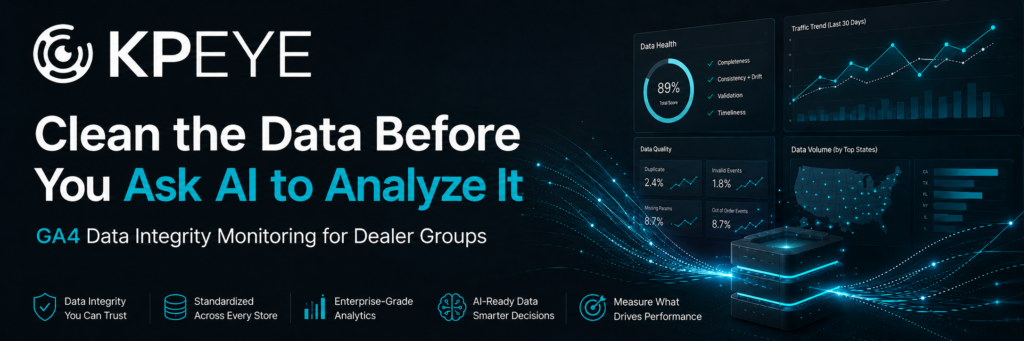
Clean the Data Before You Ask AI to Analyze It
Dealer groups are going to use AI to analyze marketing performance.
They should.
But there needs to be a step before the prompt.
Normalize the data. Validate the events. Monitor data integrity. Then let AI analyze it.
If your dealership or dealer group is preparing to use AI tools to analyze website and marketing data, KPEYE can help clean up your GA4 measurement, enforce consistent engagement and conversion standards, and evaluate every website using the same methodology across the enterprise.
We take much of the burden of GA4 data monitoring off your team so you can spend more time doing what leadership should be doing:
Making strategic decisions based on trusted data.
Dealers can enroll in KPEYE in less than five minutes, and initial reporting can be delivered within 24 hours.
Learn more at KPEYE.com.
P.S. For many larger dealer groups, I would also recommend GA4 data be pumped into BigQuery and then into Snowflake (or equivalent) but the need for KPEYE data standardization still is needed. Monitoring data quality is key for the best outcomes from AI analyze and automation.