Twenty years ago, dealer executives could walk the showroom floor and immediately identify operational problems. Today, the online showroom is often generating more opportunities than the physical showroom, yet most executives cannot inspect its health in a matter of seconds.
The larger the dealer group, the complexity of website and marketing management increases. Dealer groups need enterprise reporting which can identify immediate opportunities for improvement. Accurate data allows dealers to make data-driven decisions and not emotional decisions.
In this article you’ll learn:
- Why dealer groups struggle to inspect online performance
- The six hidden problems that suppress lead generation
- How enterprise reporting reveals opportunities at scale
- Why CTA performance varies dramatically across stores
- How reputation and pricing transparency impact conversions
Hidden Problems That Reduce Leads
As dealership leaders seek to generate more leads for their marketing investments, it is my recommendation that they first look to see how their website is tracking consumer engagement and sales opportunities. My research shows that dealers do not have time to carefully inspect:
- Which store websites (platform + tools) are not sending form, chat, and voice conversions into Google Analytics
- Which stores have too many GTM containers which can which can impact page load times and hurt conversion.
- Which stores have too many Google Analytics and old Google Ads accounts connected to their website which can impact page load time and hurt conversions.
- What are the true number of conversions from marketing campaigns from paid media campaigns, which translate to a lead in the CRM.
- Which CTA buttons are performing best for new and used car merchandising pages.
- Which websites are struggling to pass Google Page Speed Insights report for mobile devices?
Dealers can’t expect Google Ads to generate more leads if the website conversion signals it needs to make better bidding decisions are missing or replaced with weaker engagement signals.
Enterprise Reporting Accelerates Filling Gaps
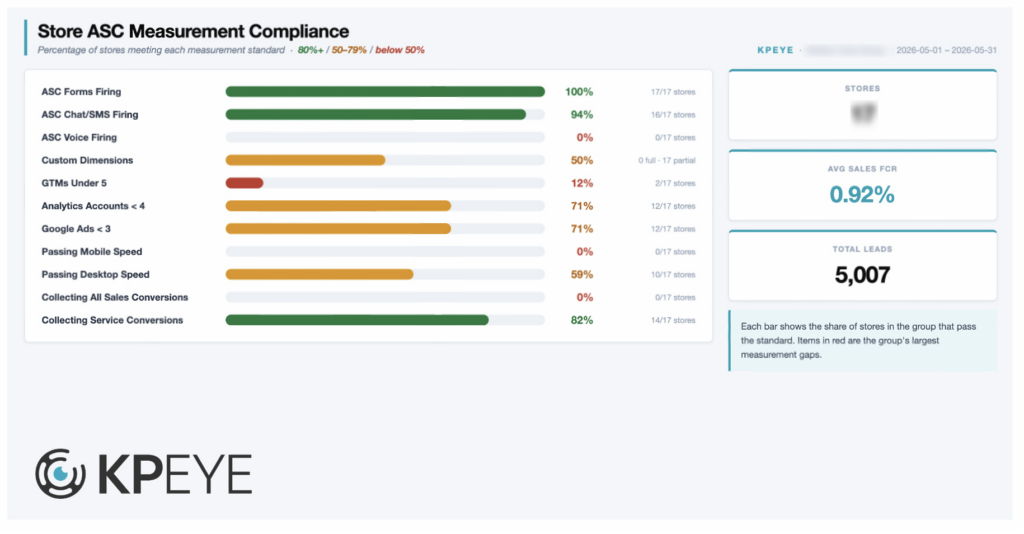
Instead of auditing stores one by one, executives can instantly identify where the largest opportunities exist. In Figure 1.0, dealers can see how their measurement and performance metrics are tracking. Dealer groups need the same performance metrics across all stores in the group.
Real Example
In one dealer group (Figure 1.0), not a single website was sending voice conversion events into Google Analytics. Yet phone calls represented a significant percentage of shopper interactions. The problem was invisible until the data was reviewed at scale.
Think about that for a moment.
A dealer group spending millions of dollars on advertising had zero phone call conversions flowing into Google Analytics across every rooftop. Google could not optimize toward signals it never received.
The dealer group also has a problem with website mobile speed scores: none of their websites pass the Google Page Speed Insights report scorecard. See the header graphic for details, at scale. Opportunities for improvement (at scale) can be identified by enterprise reporting.
What Thousands of CTA Clicks Reveal
Most dealers assume they know which CTA buttons work best. The data often tells a different story.
When we analyzed dozens of stores and OEM brands, CTA behavior begins to reveal shopper intent patterns. Our research has shown that CTA buttons perform very differently on SRPs and VDPs, as well as on different OEM brands.
Dealers should optimize each store separately but there are some insights into what consumers want by looking at CTA performance at scale. The data in Figure 2.0 is for one dealer group which is testing different CTA buttons and conversion tools.
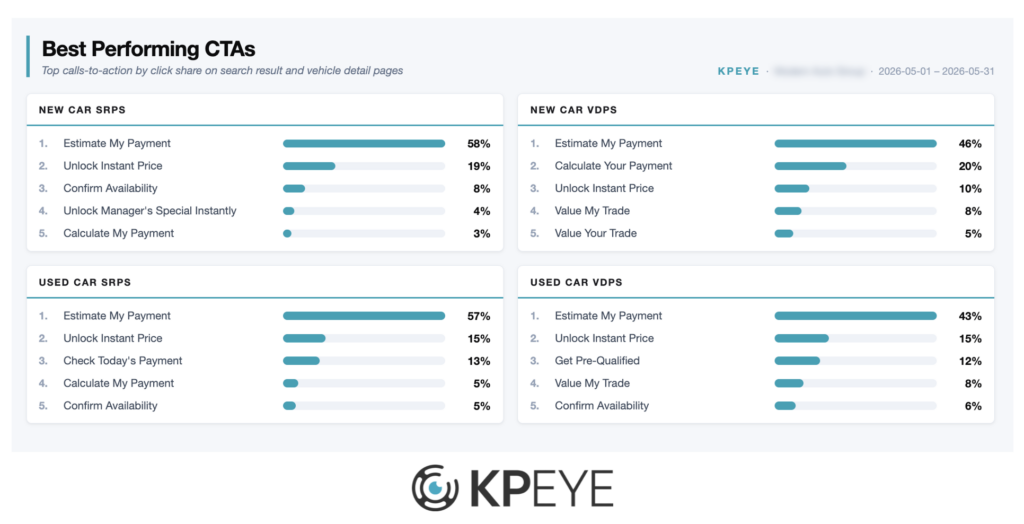
For example, the “Unlock” price CTA on new car SRPs is performing so poorly. The data raises an important question:
Should dealers continue prioritizing Unlock Price CTAs on new vehicle SRPs when alternative CTA options consistently outperform them?
In this dataset, payment-oriented CTAs significantly outperformed Unlock Price CTAs. That doesn’t mean every dealer should remove Unlock Price. It means every dealer should test assumptions against real shopper behavior.
Here is another question to consider: If dealers start listing all fees, will the value of unlock CTA be reduced?
Who knows? My suggestion is that dealers test all areas of their website which impact conversion rates.
External Factors Impacting Conversion Rates
Conversion rates are not solely determined by website design. Reputation, pricing transparency, inventory quality, and customer experience all influence shopper behavior.
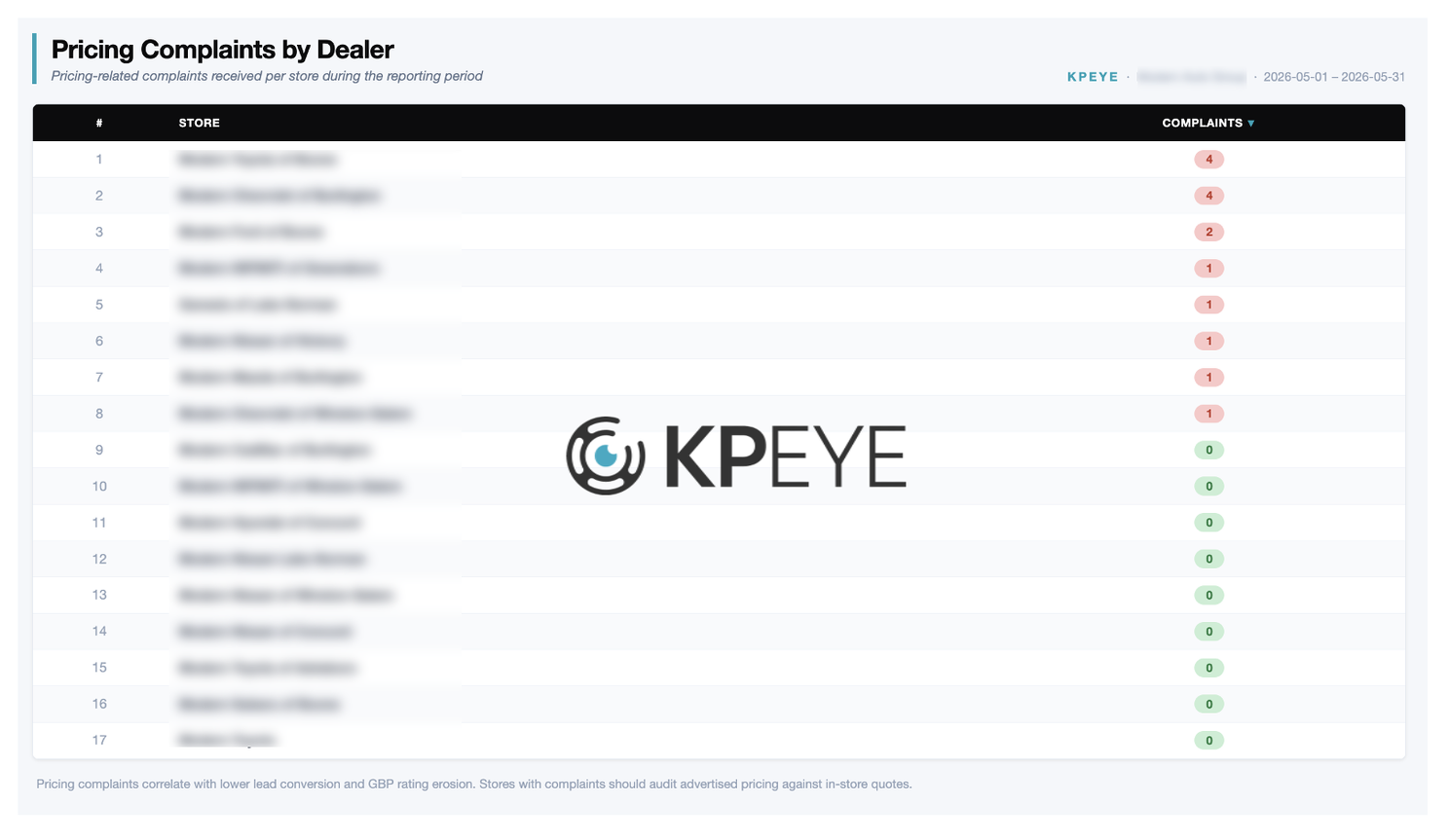
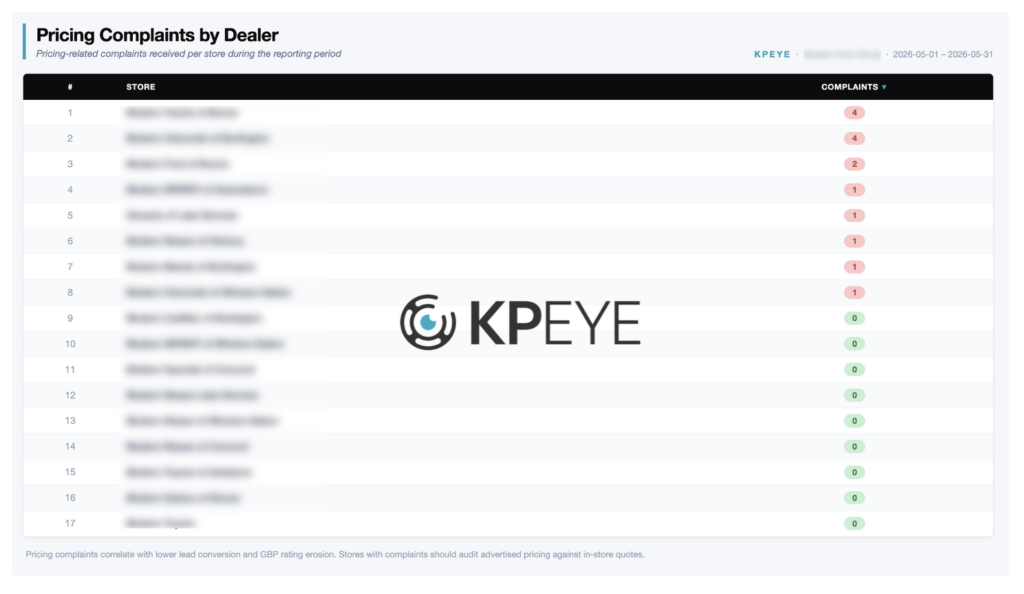
With the FTC’s focus on dealer pricing and transparency, dealer groups need to know if the most recent 50 online reviews indicate complaints about price transparency or undisclosed fees. This report (Figure 3.0) makes enterprise monitoring very easy.
Why Scale Matters
A single dealership may not produce enough data to identify meaningful patterns. But when data is normalized across dozens of stores, trends become impossible to ignore. Having instant access to:
- Top converting websites by OEM brand
- Top performing Google Ads campaigns for sales and service
- Top performing paid social media campaigns
- Stores with declining form conversion rate (FCR)
- Store with an increase is complaints about price transparency
- Stores with string growth in organic traffic and conversions.
gives dealer executives the opportunity to dig in and see what they can learn to help to spread the best strategies for selling cars in a digital age.
The goal of KPEYE is not simply to identify winners and losers. The goal is to discover repeatable patterns that can be shared across the entire organization. When one store consistently outperforms the group, executives should immediately ask:
“What can we learn from them?”
Inject Trusted Enterprise Reporting Into Your Online Strategy
Dealer groups spend millions of dollars every year driving shoppers to their websites. The question is no longer whether data exists. The question is whether executives can see the right data quickly enough to act on it.
The future belongs to dealer groups that can inspect their online showroom as easily as they inspect their physical showroom. Dealers who would like to see how KPEYE enforces visibility and accountability across all stores and tech stacks, reach out to our team at https://kpeye.com